
Blog
Oridzin: The Future After GTA V and Minecraft

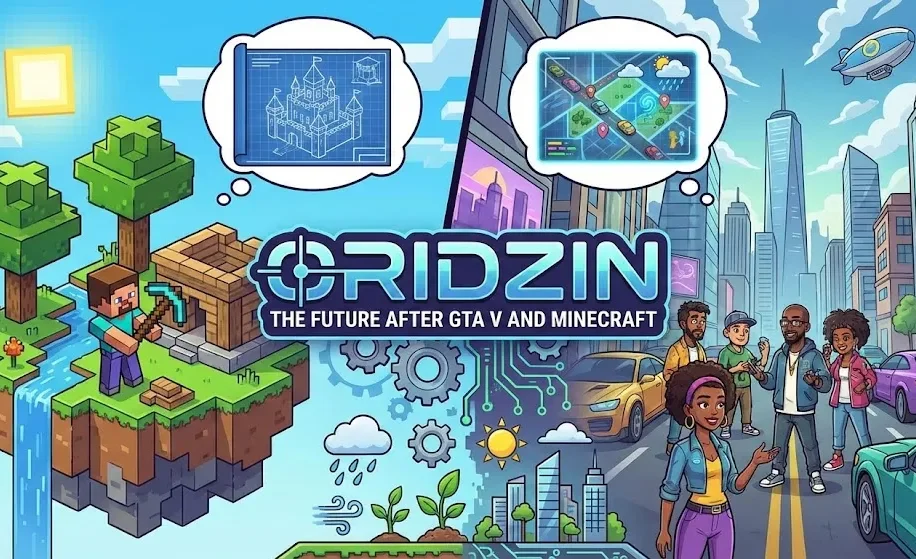
Nobody asked for another game engine. We’ve got Unreal, Unity, CryEngine—tools that already power some pretty incredible open worlds. But Oridzin isn’t real, and maybe that’s the point. It’s a thought experiment about where open-world games could go if developers stopped recycling the same tricks GTA V used back in 2013.
Worlds That Don’t Wait for You
The core idea: a world that doesn’t wait for you. Most open-world games freeze when you’re not looking. That bandit camp you cleared in Skyrim? Still empty three years later. The forest you burned down in Far Cry? Grows back on a timer, sure, but it’s scripted. Oridzin proposes something actually dynamic—ecosystems that function whether you’re there or not.
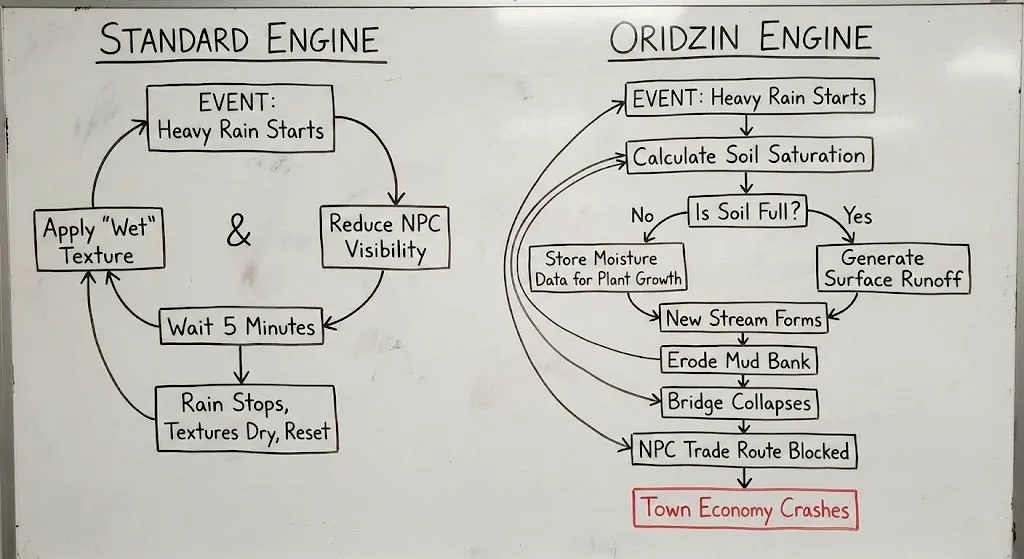
Rain doesn’t just make surfaces wet for five minutes. It pools, forms streams, and carves gullies if it keeps coming. A forest fire spreads based on wind and fuel, not because a quest designer placed burn zones. NPCs don’t stand in the same tavern forever—they move between settlements based on trade routes, safety, and opportunity.
Red Dead Redemption 2 got close to this with its camp system and NPC schedules. You could track the same stranger across multiple locations, watch gang hideouts repopulate over time. But it was still controlled chaos. Everything happened because Rockstar scripted it that way. The world felt alive, but it wasn’t actually making decisions.
How Minecraft and GTA Handle Different Problems
Minecraft handles world generation differently. Infinite terrain, player-driven changes, permanent destruction, and creation. You can reshape continents if you’ve got the time. But it’s static in other ways—mobs spawn on predictable patterns, biomes don’t shift, there’s no weather erosion or geological change beyond what you cause directly.
Oridzin would merge these approaches. Minecraft’s building freedom meets GTA’s populated urban spaces, meets something new—environmental memory. A city grows over decades of in-game time. Maybe you’re not even playing during that stretch, but when you return, neighborhoods have expanded, old buildings deteriorated, and new NPCs have established themselves.
The Technical Reality Nobody Wants to Discuss
This creates obvious technical problems. Processing a living world constantly requires serious computational power. Even when you’re offline? That seems impossible without some clever shortcuts—procedural generation that appears to have happened naturally, state changes calculated retroactively based on time elapsed, and regional conditions.
The Breath of the Wild comparison makes sense for physics. That game let you manipulate elements in creative ways—start grass fires, create updrafts, freeze water. But it didn’t remember those changes. Burn a forest, and it respawns. Oridzin would need to track alterations permanently while still keeping file sizes reasonable.
Survival games like Rust or ARK already handle persistent worlds where players affect long-term change. But they’re multiplayer-focused, which distributes the simulation load and makes the “living world” feel more natural since other humans drive most changes. A single-player engine attempting this faces different challenges.
Building in a Living City
Then there’s the building system. GTA Online lets you own properties and customize vehicles, but you’re not reshaping Los Santos. Minecraft gives you total freedom but lacks GTA’s detail and density. Combining them means letting players construct detailed buildings in a populated city, then watching that city react—property values shift, traffic patterns change, NPCs comment on or use your structures.
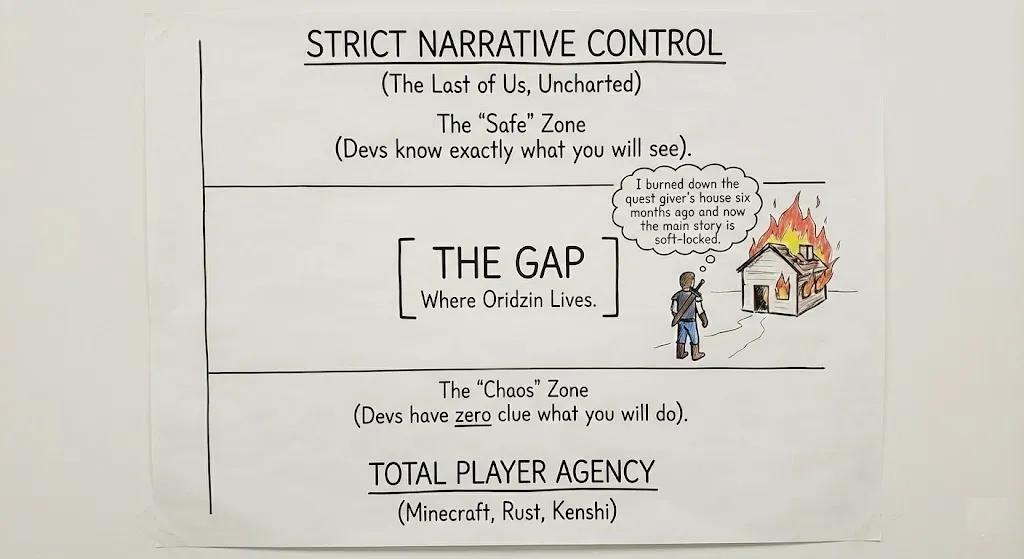
Would developers actually want this? Maybe not. Controlled experiences tell better stories. When Rockstar designs a mission, they know exactly what the world looks like, where NPCs will be, and what resources you have access to. A truly dynamic world breaks that control. Your carefully paced emotional moment gets ruined because an NPC migration happened to empty the town you needed populated.
When Procedural Generation Creates Problems Instead of Solutions
Procedural generation already causes this problem. No Man’s Sky generates billions of planets, but most feel empty and sameless because algorithms can’t craft meaningful content the way human designers can. Oridzin would need to balance procedural systems with authored content, which sounds like trying to have two incompatible things at once.
The bigger question: does anyone actually want a world this unpredictable? Part of GTA V’s appeal is consistency. You know where to find certain vehicles, which areas are dangerous, and how NPCs will react. Learning a game’s systems matters. If everything constantly shifts, that knowledge becomes worthless.
Why Niche Games Already Do This Better
Simulation games like Dwarf Fortress prove that some players love emergent chaos. Every fortress tells a different story based on environmental factors, random events, and cascading failures. But that’s a niche audience compared to the mass-market appeal of Assassin’s Creed or Red Dead.
Still, the concept pushes at interesting boundaries. What if a game remembered every tree you cut down, every building you entered, every NPC you interacted with? Not just in a quest-completion way, but as permanent marks on a living system. You’d create a unique version of the world just by playing normally.
Storage Requirements From Hell
Save file sizes would be absurd. Modern open-world games already push storage limits tracking player progress, unlocked areas, and completed objectives. Adding environmental state data for potentially millions of individual objects and NPCs? You’d need compression algorithms that don’t exist yet.
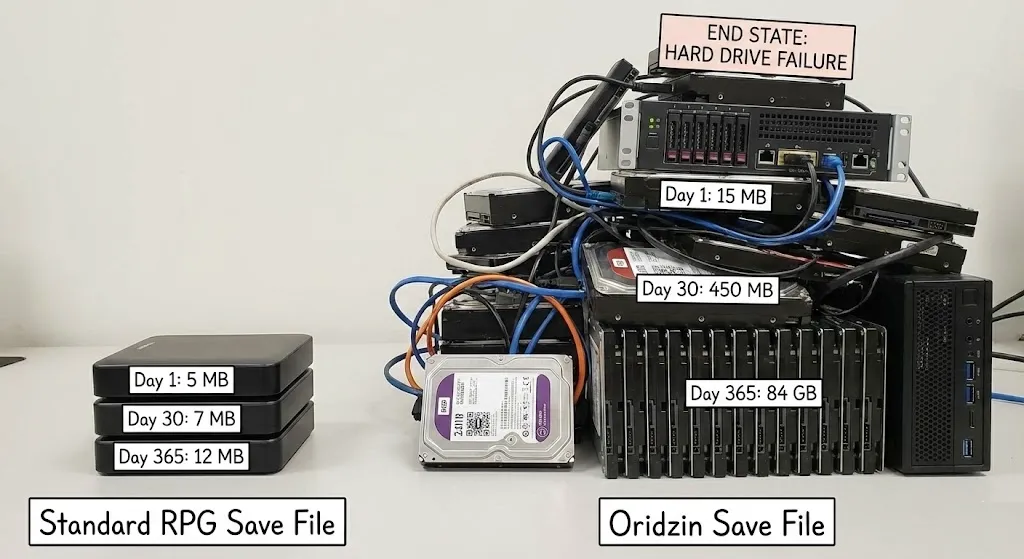
Maybe that’s why Oridzin remains fictional. The technology isn’t there. The demand isn’t proven. The design challenges outweigh the benefits for most game types. But as a benchmark for where things could go—past static worlds that pretend to be alive, toward systems that actually function independently—it highlights how much room remains for innovation.
GTA VI is coming eventually. Elder Scrolls VI, too. They’ll probably iterate on existing formulas rather than revolutionize them. Safer that way. But somewhere in the gap between what’s profitable and what’s possible, ideas like Oridzin exist. Useful as targets even if we never quite reach them.